Protocol Fee Operations
This page describes how protocol fees are collected and processed through Balancer's safe infrastructure.
Fee Structure Overview
| Fee Type | Balancer v2 | Balancer v3 |
|---|---|---|
| Yield Fees | 50% | 10% |
| Swap Fees | 50% | 25% |
Key Changes in v3
- Reduced yield fees from 50% to 10% to increase adoption
- Universal 25% swap fees across all pools
- Simplified fee distribution model
- Introduction of boosted pools technology
Swap Fees
Balancer collects a percentage of swap fees paid by traders. From the swapper's perspective, there is no price increase: the protocol fee is taken as a fraction of the fee already being collected for liquidity providers.
Yield Fees
Protocol fees are applied to yield earned by yield-bearing assets with rate providers. The percentage differs between V2 (50%) and V3 (10%), with V3's reduced rate designed to drive adoption of boosted pools technology.
Boosted Pools
V3 introduces boosted pools that deploy underlying liquidity into yield-generating markets, allowing any token with an external yield market to be transformed into a yield-bearing asset.
Flash Loan Fees
Flash loans allow users to borrow assets without collateral, as long as the borrowed amount is repaid within the same transaction. In Balancer V2, governance had the ability to set flash loan fees, but they were always set to zero to encourage developers to build on Balancer. In V3, flash loans operate through the Vault's transient unlock mechanism and remain fee-free by design.
Fee Collection Infrastructure
Protocol fees are collected differently for Balancer V2 and V3, but both ultimately flow through the Protocol Fees Multisig (also known as the Fee Collector Safe) on Ethereum mainnet for distribution.
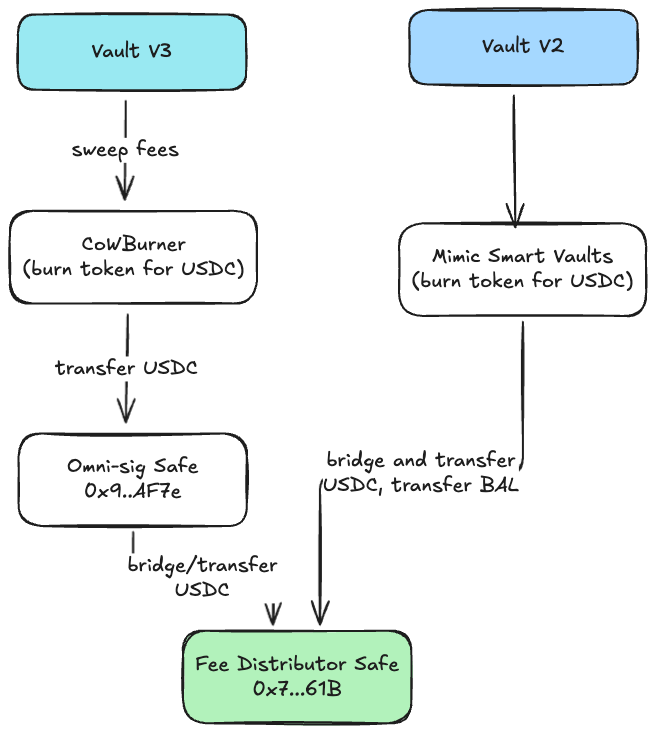
Balancer V3 Collection
V3 fees are swept from pools using burner contracts to the Omni-sig on each chain, then bridged to Ethereum mainnet and transferred to the Protocol Fees Multisig.
Balancer V2 Collection
V2 fees are processed by Mimic infrastructure, which handles swapping collected tokens to USDC, bridging from L2s to mainnet, and transferring to the Protocol Fees Multisig.
Fee Distribution Flow
Updated by BIP-919. The protocol fee rates and routing were materially restructured by BIP-919 (BAL Tokenomics Revamp). 100% of all protocol fees now route to the DAO Treasury via the corporate entities. The prior fee-sharing splits to veBAL holders, core-pool voting incentives, partners, and the Balancer Alliance program have all been terminated.
Corporate Structure Flow
From the Balancer Onchain Ltd Safe, the DAO's share flows up the corporate structure:
- Balancer Onchain Ltd Safe receives the DAO portion
- Dividends flow to Balancer OpCo Ltd Safe
- Dividends flow to Treasury Safe for ecosystem reserves
Governance Controls
Protocol Fees Multisig
The Protocol Fees Multisig (0x7c68c42De679ffB0f16216154C996C354cF1161B) controls fee collection and initial distribution. It operates under the 1/2 operational multisig configuration with Balancer Onchain Ltd Safe and Operator Safe as signers.
Fee Parameter Changes
Routine protocol fee parameter changes fall under the core team's operational mandate (per BIP-918) and do not require a Snapshot vote; the DAO Multisig or appropriate chain-specific multisig executes them. Major changes — such as BAL supply or minting parameters — still require a governance vote.
Related Documentation
- Pool Token Compatibility - Token requirements for Balancer pools (and historical core-pool context)
- Multisig - Safe infrastructure and signer groups
- Corporate Structure - Legal entity hierarchy